Bill Patterson
It is difficult to know when I first thought photography might be an interesting thing to do. I vaguely remember being given an ancient small bellows camera (taking 127 film) to play with, and then from about the age of ten or eleven getting the occasional film to shoot and have developed and printed at the chemists. Black and white photo printing was sometimes useful for Uni projects, so I got to use the facilities there, taking pictures with a basic 35mm camera from Boots. I think you just had to guess the exposure, from the weather.
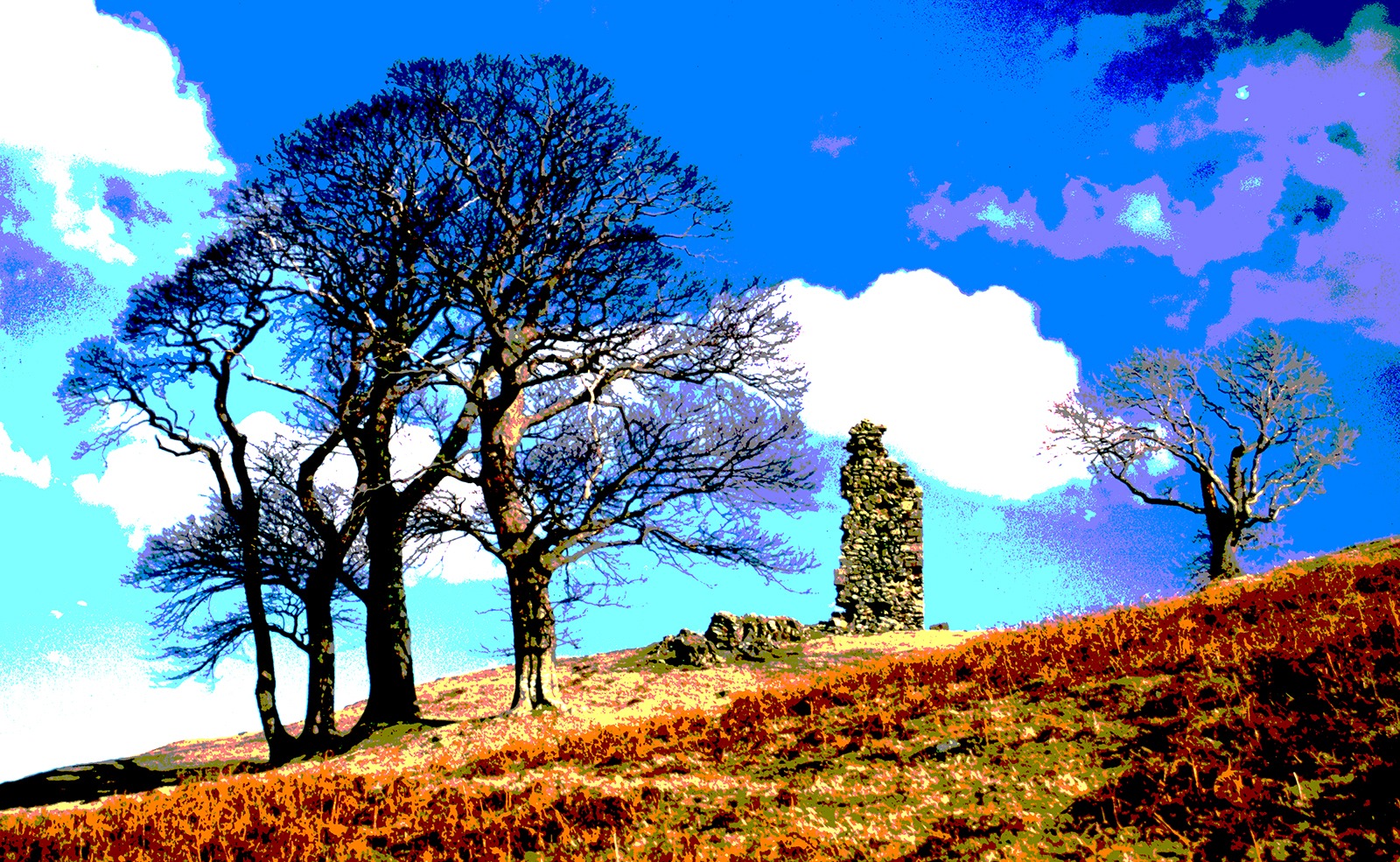
Later the camera club in Clydebank was right next to where I worked there, so I also used their dark room for a while, but found that I had much more interest in taking colour slides. I still have many of the early slides, though I have had to throw out hundreds which were ruined by moulds, but in retrospect the quality that my cheapo camera and usually cheapo film produced was, in comparison with modern digital, like 1960s/70s TV beside today’s 4K LCD screens. Even after digital enhancement the colour in the 1975 summer afternoon photo is almost as far from today’s expectations as are the three parked cars in a street that is now decorated with yellow lines and usually has nose-to-tail parked vehicles and often nose-to-tail traffic. My first slide scanner and photo printer produced such unreal colours that I mostly turned the photos into posterised or other false colour pictures using crude software, as with the photo of Hirendean Castle.
Since I enjoy hill walking many of my photos have been taken on walks; I am at least as keen on cycling but riding a bike is not so camera-friendly. With the exceptions of water and my children and grandchildren at very young ages, I have seldom had much inclination to take photos of anything that moves: so no sport, and hardly ever animals or birds, though I enjoy action photos by those who have the skill and/or patience and stamina to get dramatic sport photos or incredible wildlife shots. Street photography is something that I greatly enjoy seeing, and wish I had the sheer cheek to do more of. But landscapes and buildings are my most usual subjects, though I try to look out for nearer details such as the reflections from ice at Pressmennan Loch.
Although I have nothing against cloning out temporary intrusions such as cars or leaves in the wrong place for a composition, and any digital photo will need adjustments such as dodging, burning and colour adjustments, my interest in interpreting the landscape rather than trying to create a pretty or exciting picture for its own sake leads to a rather puritanical attitude towards deeper manipulation such as shifting rocks or removing trees. Whilst minimalist photos with a single point or pattern of interest can have strong immediate impact, they can soon sate and I also see a place for more complicated designs which invite the viewer to spend some time exploring around the details. Similarly, perhaps, I am not as allergic as some to the inclusion of a lot of empty space in a landscape photo; a principal subject may need that context to express its character.
Sometimes photographic opportunities are unexpected, like the surreal mannekin that someone has set up by a ‘road less taken’ in a local wood; or the view out through the window of the Seabird Centre’s café with a storm raging outside; it was not expected to be any good and it was nearly deleted when first seen on screen, but I realised that with minimal enhancement it could tell a simple story. Many might still think it should have been an automatic reject but a competition judge liked it.
Please click on the image below, to open the scrollable gallery